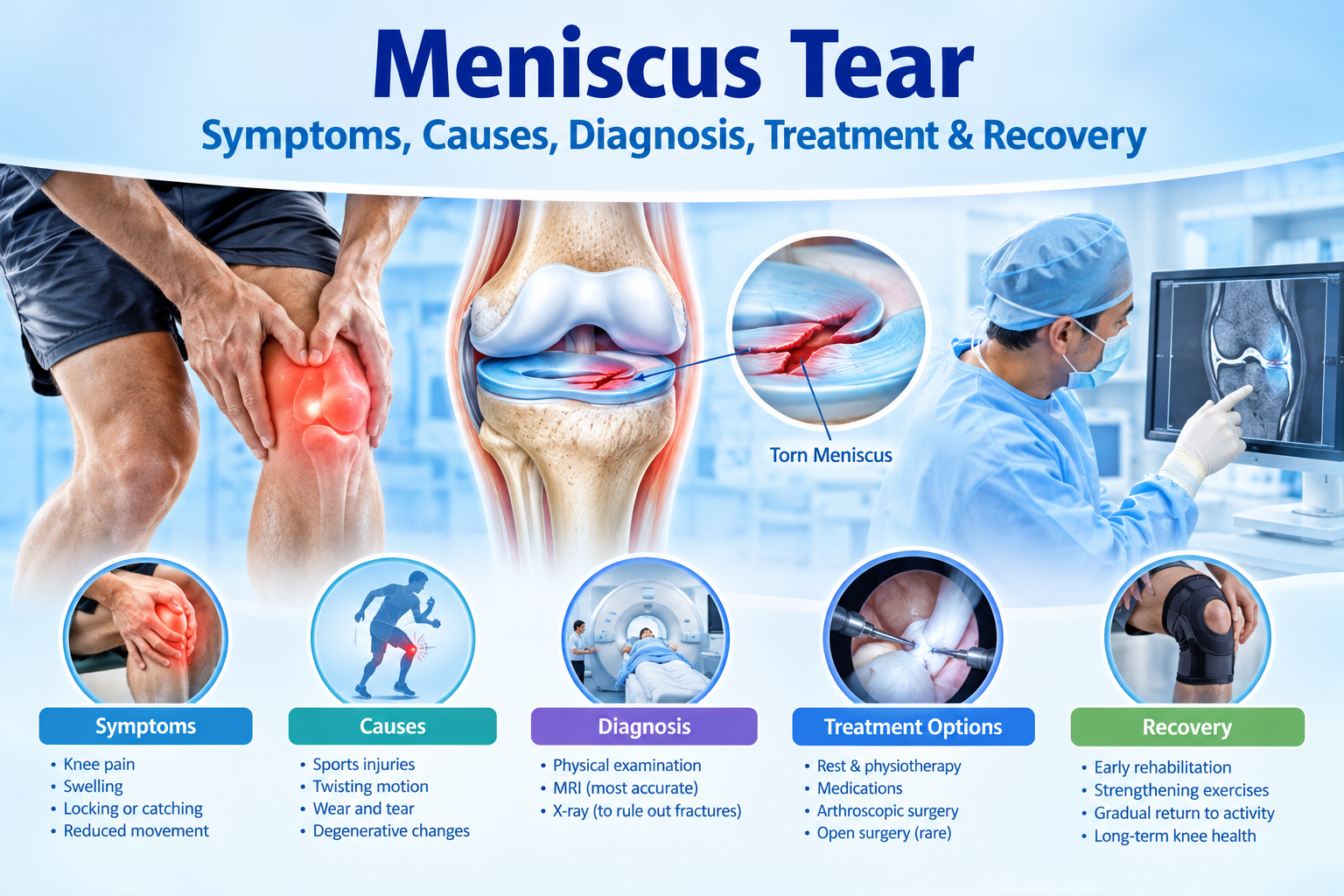
A meniscus tear is one of the most common knee injuries, particularly among athletes, active adults, and older people. The menisci are two crescent-shaped pieces of cartilage inside each knee that act as shock absorbers between the thighbone and shinbone.
A sudden twisting movement, sports injury, fall, or age-related wear and tear can damage the meniscus. Symptoms may range from mild knee pain to swelling, stiffness, clicking, or difficulty fully bending or straightening the knee.
But does every meniscus tear require surgery? Not necessarily. Treatment depends on the location and severity of the tear, the patient’s age and activity level, associated knee damage, and how symptoms affect daily life.
This guide explains meniscus tear symptoms, causes, diagnosis, treatment options, recovery, and when surgery may be necessary.
What Is a Meniscus Tear?
A meniscus tear is a tear or injury to the cartilage that sits between the thighbone (femur) and shinbone (tibia).
Each knee has two menisci:
- Medial meniscus – located on the inner side of the knee
- Lateral meniscus – located on the outer side of the knee
They help distribute weight, absorb shock, improve knee stability, and allow smooth movement.
A meniscus can tear during a sudden twisting or pivoting movement. In older adults, the cartilage can become weaker with age, making it more vulnerable to tears during ordinary activities.
Meniscus Tear Symptoms
The symptoms of a torn meniscus can vary depending on the type and severity of the injury.
Common Meniscus Tear Symptoms
- Knee pain, particularly while twisting or turning
- Swelling around the knee
- Knee stiffness
- Difficulty bending or straightening the knee
- Clicking or popping sensation
- A feeling that the knee is catching or locking
- Difficulty putting weight on the affected leg
- Feeling that the knee may give way
Some people may continue walking after a meniscus injury, particularly when the tear is small. However, persistent symptoms should be evaluated by an orthopedic specialist.
Does a Meniscus Tear Always Cause Severe Pain?
No. Pain can range from mild to severe. Some people experience swelling and stiffness rather than significant pain.
The absence of severe pain does not necessarily mean that the injury is minor.
What Causes a Meniscus Tear?
Meniscus tears generally occur because of either a sudden injury or gradual degeneration.
Sports and Twisting Injuries
Sports involving sudden changes in direction, pivoting, squatting, or twisting can increase the risk.
Common examples include:
- Football
- Basketball
- Tennis
- Cricket
- Soccer
- Running and other high-impact activities
A forceful twisting motion while the foot is planted can place significant stress on the meniscus.
Age-Related Meniscus Injury
As people age, the meniscus becomes less flexible and more susceptible to degeneration.
A degenerative meniscus tear can sometimes occur during relatively ordinary movements such as squatting or getting up from a chair.
Other Risk Factors
Risk may also increase with:
- Previous knee injuries
- Repetitive physical activity
- Certain occupations involving frequent squatting or kneeling
- Poor knee mechanics
- Associated ligament injuries
How Is a Meniscus Tear Diagnosed?
If you have persistent knee pain or symptoms after an injury, an orthopedic doctor will usually begin with a physical examination.
The doctor may assess:
- Knee movement
- Tenderness
- Swelling
- Stability
- Pain during specific movements
Imaging Tests
X-Ray
X-rays do not usually show the meniscus itself, but they can help rule out fractures or arthritis.
MRI
An MRI is commonly used to evaluate soft tissues such as the meniscus, ligaments, and cartilage. It can help identify the location and extent of a tear when clinically appropriate.
Early and accurate diagnosis can help determine whether conservative treatment or surgery is more appropriate.
Types of Meniscus Tears
Meniscus tears can have different patterns and locations.
Some common patterns include:
- Horizontal tears
- Vertical tears
- Radial tears
- Flap tears
- Complex tears
- Bucket-handle tears
The location of the tear is particularly important because some areas of the meniscus have a better blood supply than others.
Tears in areas with better blood supply may have greater potential for healing, while tears in areas with limited blood supply may be less likely to heal on their own.
Meniscus Tear Treatment Options
Treatment depends on the patient’s symptoms, age, activity level, tear pattern, location, and whether other knee structures are injured.
Meniscus Tear Treatment Without Surgery
Not every meniscus injury requires an operation.
For selected tears, doctors may initially recommend conservative treatment such as:
Rest and Activity Modification
Avoiding activities that worsen pain can give the knee time to settle.
Ice
Cold therapy may help reduce pain and swelling during the early stage of an injury.
Medication
Doctors may recommend appropriate pain-relieving or anti-inflammatory medicines when suitable for the individual patient.
Physiotherapy
A structured physiotherapy program can improve:
- Knee flexibility
- Muscle strength
- Joint stability
- Balance
- Functional movement
Physiotherapy may be particularly useful when symptoms can be controlled without surgery.
Can a Meniscus Tear Heal Without Surgery?
Some meniscus tears can improve without surgery, particularly when the tear is small, stable, located in an area with better blood supply, or associated symptoms can be managed with conservative treatment.
However, the ability of a meniscus to heal depends strongly on the tear’s location and characteristics.
A doctor may recommend monitoring and non-surgical treatment when symptoms are manageable and there is no significant mechanical problem.
Persistent locking, significant instability, or ongoing symptoms despite appropriate conservative treatment may require further evaluation.
When Does a Meniscus Tear Require Surgery?
Surgery may be considered when:
- Symptoms persist despite conservative treatment
- The knee repeatedly locks or catches
- The tear is unstable
- There is significant mechanical dysfunction
- The injury occurs alongside other knee damage
- The tear is suitable for surgical repair
The decision should be based on the individual’s symptoms and clinical findings rather than the MRI report alone.
Meniscus Repair Surgery
When possible, surgeons may repair the damaged meniscus rather than remove it.
Meniscus repair involves stitching the torn cartilage together to preserve as much healthy meniscal tissue as possible.
Preserving the meniscus is important because it contributes to shock absorption and protection of the knee joint.
However, not every tear is repairable. The decision depends on factors such as:
- Tear location
- Tear pattern
- Tissue quality
- Blood supply
- Patient age
- Activity level
- Associated injuries
Knee Arthroscopy and Meniscus Surgery
Knee arthroscopy is a minimally invasive procedure in which a small camera is inserted into the knee through a small incision.
Depending on the injury, the surgeon may perform:
- Meniscus repair
- Partial meniscectomy
- Removal of unstable damaged tissue
- Treatment of associated knee problems
The goal is to relieve symptoms while preserving as much healthy meniscus as possible.
Meniscus Tear Recovery
Recovery time depends on whether the injury is treated conservatively or surgically.
Non-Surgical Recovery
People with less severe injuries may gradually return to normal activities as pain and swelling improve and strength returns.
After Meniscus Repair
Recovery after meniscus repair generally takes longer because the repaired tissue needs time to heal. Temporary restrictions on weight-bearing and knee movement may be recommended.
After Partial Meniscectomy
Recovery may be quicker in appropriate cases because there is no repaired tissue that needs the same healing period.
Your orthopedic surgeon and physiotherapist will provide an individualized rehabilitation plan.
Exercises for Meniscus Tear Recovery
Once your healthcare provider considers exercise appropriate, rehabilitation may focus on:
- Quadriceps strengthening
- Hamstring strengthening
- Range-of-motion exercises
- Balance training
- Low-impact functional exercises
Exercises should be introduced progressively. Avoid exercises that increase pain, swelling, or mechanical symptoms without professional guidance.
What Happens If a Meniscus Tear Is Left Untreated?
Not every untreated meniscus tear causes serious problems. Some small or degenerative tears may remain manageable.
However, persistent symptoms should not be ignored.
An unstable tear can cause ongoing pain, swelling, catching, or locking. In some cases, untreated knee problems may contribute to changes in joint function and mobility.
If knee symptoms continue after an injury, an orthopedic evaluation can help determine the appropriate course of action.
Meniscus Tear vs Other Causes of Knee Pain
Knee pain doesn’t always mean you have a meniscus injury.
Similar symptoms can occur with:
- ACL injuries
- Ligament sprains
- Osteoarthritis
- Patellar problems
- Cartilage injuries
- Tendon injuries
Pain that travels from the lower back into the leg may also have a spinal or nerve-related cause. Understanding the difference between slip disc and sciatica can help distinguish certain types of back and leg pain from a knee-related problem. This is why professional assessment is important before starting treatment.
If you’re experiencing persistent knee discomfort, you can also explore our guide to knee pain treatment in Hassan.
When Should You See an Orthopedic Doctor?
Consult an orthopedic specialist if you experience:
- Persistent knee pain after an injury
- Significant swelling
- Knee locking
- Difficulty straightening the knee
- Repeated clicking with pain
- Knee instability
- Difficulty walking or bearing weight
Seek prompt medical attention after a significant injury, particularly if you cannot bear weight or the knee becomes severely swollen or deformed.
If knee pain is accompanied by persistent back pain, numbness, weakness, or pain extending into the leg, further evaluation may be needed to determine whether the symptoms are related to the spine rather than the knee. For patients undergoing evaluation for more complex spinal conditions, understanding the potential spine surgery in Hassan costs and treatment factors can also be useful when discussing care options with a specialist.
Meniscus Tear Treatment in Hassan
Patients looking for meniscus tear treatment in Hassan should consider a hospital with experienced orthopedic specialists, appropriate diagnostic facilities, and access to physiotherapy and surgical care when required.
Karna Hospital provides comprehensive orthopedic evaluation and treatment for various knee conditions.
Learn more about the orthopedic hospital in Hassan and available orthopedic care.
Frequently Asked Questions
What are the first symptoms of a meniscus tear?
Common early symptoms include knee pain, swelling, stiffness, clicking, catching, and difficulty bending or straightening the knee.
Can a meniscus tear heal on its own?
Some tears may improve without surgery, particularly small or stable tears in areas with better blood supply. However, healing potential depends on the tear’s location and characteristics.
Can you walk with a torn meniscus?
Yes, some people can walk with a meniscus tear, particularly when the injury is mild. However, walking does not mean the injury should be ignored.
Does every meniscus tear require surgery?
No. Many meniscus injuries can initially be managed with conservative treatment and physiotherapy. Surgery may be considered for persistent symptoms, unstable tears, or mechanical problems such as locking.
How long does a meniscus tear take to heal?
Recovery varies significantly. Mild injuries may improve over weeks with appropriate treatment, while recovery after meniscus repair can take several months.
What is the best treatment for a meniscus tear?
There is no single best treatment for every patient. Treatment may include activity modification, medication, physiotherapy, meniscus repair, or arthroscopic surgery depending on the individual injury.
Conclusion
A meniscus tear can result from a sudden sports injury, twisting movement, or age-related degeneration. Common symptoms include knee pain, swelling, stiffness, clicking, catching, and difficulty moving the knee.
Treatment depends on the type and location of the tear and the patient’s symptoms. Some injuries improve with rest, activity modification, medication, and physiotherapy, while unstable or persistent tears may require meniscus repair or arthroscopic surgery.
Early assessment is important when symptoms such as persistent pain, locking, swelling, or instability occur. A qualified orthopedic specialist can determine whether conservative treatment, rehabilitation, or surgery is appropriate.